- Home
- Refill my account
- Sign Up
- Log in
- Our blog
- Contact us
- FAQ
- Language
When we pull cards in a tarot reading, most of us wait for the big ones — The Fool, The Lovers, The Moon. The Major Arcana shine brightly, grabbing all the attention. But what about the quieter cards, the ones that whisper instead of shout? The Minor Arcana may be less showy, yet they form the living fabric of everyday life, where our choices, emotions, and small actions take shape.
Composed of 56 cards divided into four suits — Cups, Pentacles, Swords, and Wands — these cards reveal how spiritual forces manifest in the tangible world. While the Majors reflect universal archetypes, the Minors describe how those energies unfold in real time. That’s where their true power lies.
Each suit, number, and court figure (Page, Knight, Queen, King) carries a precise symbolic language. If the Major Arcana tell the grand myth, the Minors record your daily logbook — more personal, more grounded, but just as essential. If you are still finding your footing with the cards, our tarot reading for beginners guide covers the full deck from first shuffle to first spread.
Their origin dates back to the « Latin tarot, » close to early Italian playing decks. Contrary to popular belief, the Minor Arcana were never an afterthought. They were there from the start, woven into a worldview based on cycles, elements, and symbolic hierarchies.
Maybe it’s time to give these subtle allies the spotlight they deserve, not as mere add-ons, but as true mirrors of your inner reality.
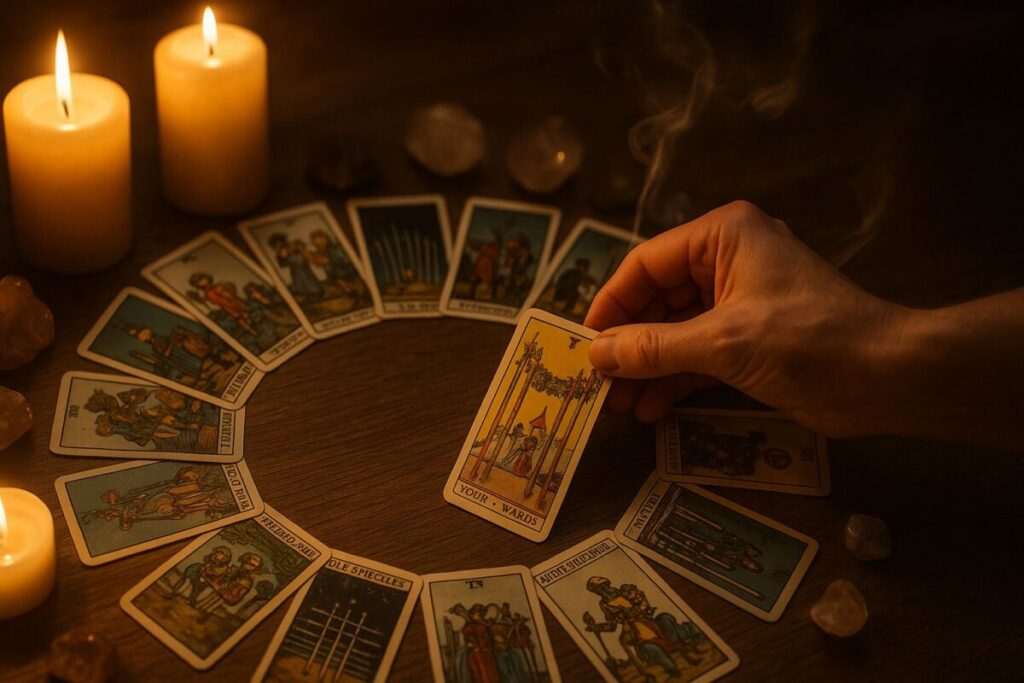
The Minor Arcana are built on four elemental families, each connected to a natural element, life area, and psychological energy:
Each suit runs from Ace to 10, tracing a full cycle of experience, followed by the court cards — Page (potential), Knight (action), Queen (intuition), King (mastery).
The beauty of the Minor Arcana lies in their precision. They illuminate everyday patterns, thoughts, emotions, interactions, choices. If the Majors ask « Why? », the Minors ask « How? » and « What now? »
Examples:
Together, these cards act as fine instruments of discernment. They rarely give yes/no answers. Instead, they offer emotional, mental, and practical direction — a compass for clarity in motion. For a deeper look at the symbolic architecture behind every pip and court card, see our companion piece on the Minor Arcana: the tarot’s hidden keys and their symbolic power.
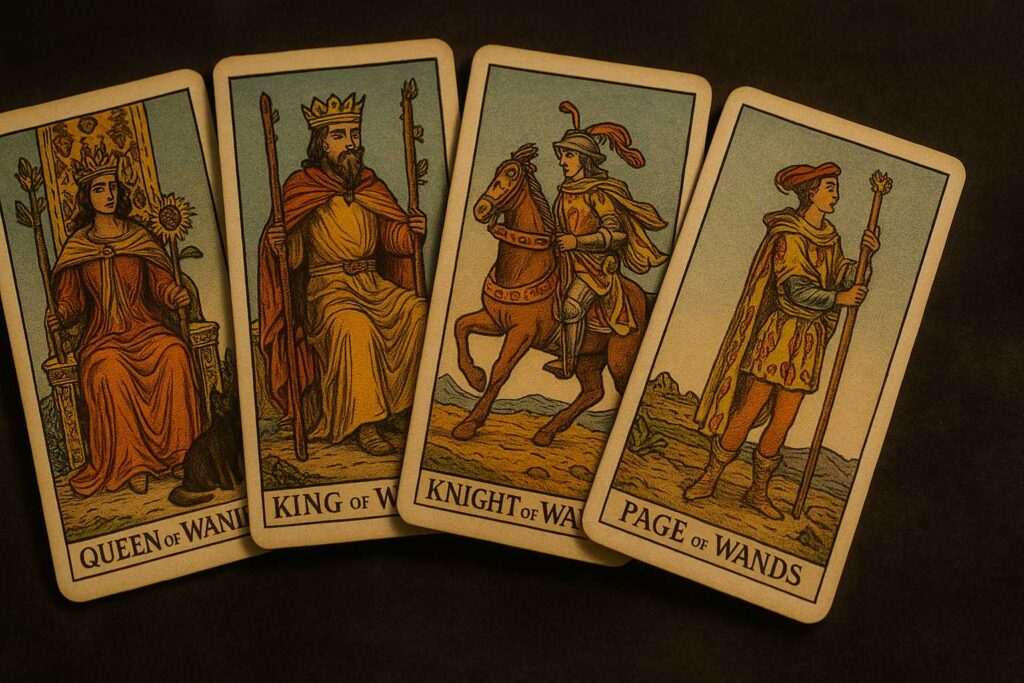
Some readings even use only the Minor Arcana, like the Seven-Day Cycle spread, one card per day, to observe shifting moods and opportunities. If that idea appeals to you, using your tarot cards as the pages of a personal journal takes this daily practice even further.
Sophie, 34, nurse: « I used to skip the Minors, too many, too subtle. Then the 6 of Cups appeared in a reading about my ex. I realized it wasn’t about him at all, but my need for tenderness and emotional safety. It changed everything. »
Joachim, holistic therapist: « The Minors help me name the invisible. They describe what’s happening now, in the body, in the mind. They refine intuition into understanding. »
Lea, student: « I learned tarot by pulling one Minor a day for a month. That’s how I started recognizing my own patterns, fears, and desires. »
No. Learn their core meanings, then let intuition complete the picture.
Not necessarily. A reading with only Minors can be incredibly grounded and insightful.
Feel them: Swords live in the mind, Wands in action. Ask yourself, am I thinking or doing?
Not always. They can mirror traits or energies within yourself that need balancing or expression.
The Minor Arcana aren’t « minor » at all. They are the subtle echoes of your daily life — small truths that weave the big picture. They don’t shout destiny; they whisper awareness. They remind you that wisdom often hides in ordinary moments.
So tonight, pull just one card. Observe. Feel. What does it awaken in you? Maybe that simple draw holds exactly the message you were meant to see.